What is Warhammer 40k?
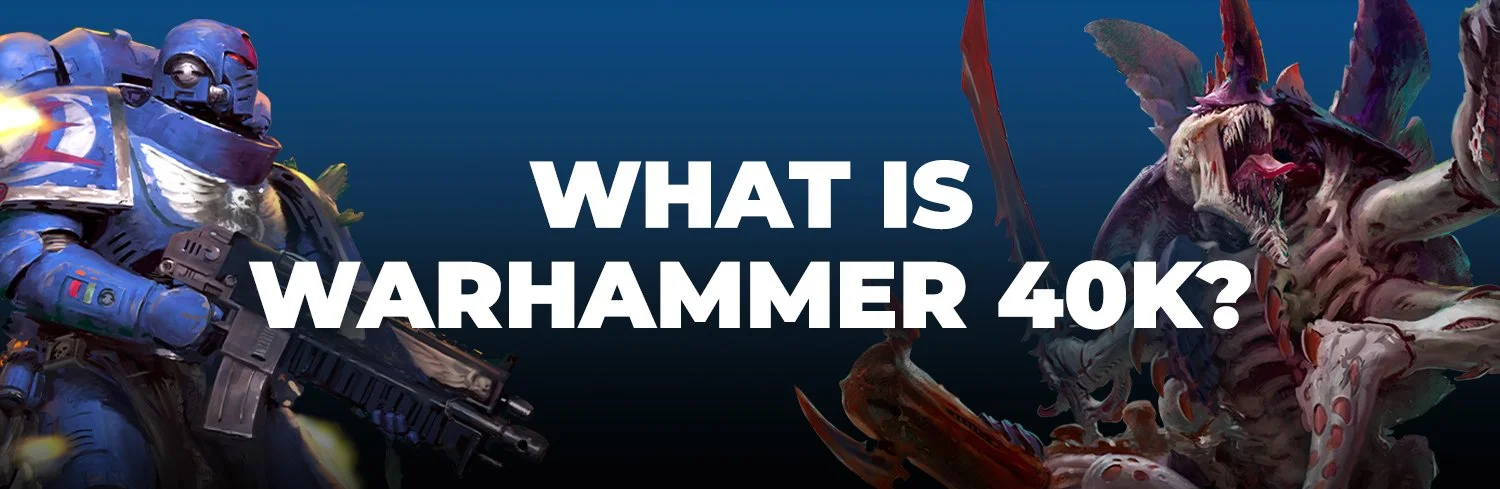
Warhammer 40,000 (often referred to as Warhammer 40k or simply 40k) is Games Workshop's flagship tabletop miniature wargame. It stands as the undisputed titan of tabletop miniature wargaming, occupying a prime position in the industry.
First released in 1987 as Warhammer 40,000: Rogue Trader, Warhammer 40k has become a household name, cementing itself as one of the most popular tabletop wargames, with an estimated 2.4 million players in 2022, and still growing.
But what exactly makes Warhammer 40k so special?
The Warhammer 40k Setting
First coined in the iconic tagline, “In the grim darkness of the far future, there is only war.” Warhammer 40k encapsulates grimdark perfectly. What is grimdark, you may ask? Grimdark is a subgenre defined by bleak, unrelenting conflict where binary heroes do not exist and morality is fractured on every front. Every character and faction fights for what they believe in, with often blurred goals and a problematic path to achieving them. Victory in a grimdark setting is often pyrrhic or fleeting, as war and suffering inevitably resurface.
This is the ideal in which the universe of Warhammer 40k resides, with 40k referring to the game set in the 41st millennium. For the Adeptus Astartes, the faction based on Terra (previously known as Earth), civilisation is not progressing; it is decaying under the weight of constant invasion, fanaticism, and existential terror. Under the direction of the God-Emperor of Mankind, the Imperium of Man, as they’re called, these religious zealots have embarked on a galactic conquest of war, laying claim to all planets they come across - and fighting off the inhabitants that exist in the name of the Emperor.
Beyond the physical galaxy lies the Warp (or the Immaterium), a parallel dimension formed from the raw emotional energy and psychic echoes of sentient beings. The Warp makes faster-than-light travel possible, but it is also the realm of the Chaos Gods, four malevolent entities whose corrupted followers constantly breach realspace to tear reality apart.
The Major Alliances
Every army in Warhammer 40k belongs to one of three broad categories: the Imperium, the Forces of Chaos, or the Xenos (alien races).
The Imperium of Man: Humanity’s vast, decaying, and fiercely defensive galactic empire. Besieged on all sides, the Imperium survives through sheer numbers, extreme religious fanaticism, and elite, genetically modified super-soldiers known as Space Marines. They rely on the cyborg tech-priests of the Adeptus Mechanicus to maintain ancient technology they no longer fully understand, sacrificing millions of lives daily just to keep the human race from going extinct.
The Forces of Chaos: The dark, corrupting mirror to the physical universe. This faction consists of nightmarish Chaos Daemons pouring out from an alternate dimension known as the Warp, fighting alongside twisted mortal traitors and Chaos Space Marines, fallen super-soldiers who rebelled against humanity millennia ago. Driven by malevolent dark gods, they seek to tear reality apart and plunge the galaxy into ruin.
The Xenos (Aliens): A catch-all term for the galaxy's diverse non-human species. Unlike the Imperium or Chaos, Xenos factions are not united. They are wildly different alien races with their own unique technologies, biologies, and goals. They range from relentless, planet-consuming biological swarms like the Tyranids and ancient, awakening robotic legions like the Necrons, to the young, high-tech T'au Empire and rowdy, war-loving brutes known as Orks. Each fights for its own survival, dominance, or amusement.
Visit our blog on how to choose your 40k faction to find out more about the lore and playstyle of each army in detail.
The Warhammer 40K Hobby
Warhammer 40,000 is not a single boxed game, it is a three-dimensional tabletop hobby divided into two distinct components: the physical crafting of your army and the tactical battles fought on the table.
Building and Painting
Before miniature models reach the tabletop, they must be constructed and painted.
Assembly: Miniatures arrive on plastic frames known as sprues. Players clip the individual components using hobby clippers, clean off small mould lines with a hobby knife, and assemble the poses using plastic cement or superglue.
Priming: A spray primer (matte black, grey, or white) is applied to ensure model acrylic paints adhere evenly to the smooth plastic.
Painting: Players use water-based acrylic paints, washes, and drybrushing techniques to bring their miniatures to life. Painting allows for complete creative control. You can match the official color schemes of famous factions or invent your own custom paint schemes, heraldry, and squad markings. Games Workshop have a line of their own paints called Warhammer Colour, which make it easy to pick classic colours and paint schemes.
Basing: The base of the miniature is textured using sand, technical texture paints, or static grass to ground the model in a thematic environment, from ruined urban streets to desolate alien wastelands.
For many enthusiasts, this hobby side of Warhammer 40k provides the majority of the enjoyment, offering a hands-on, creative outlet completely separate from the tabletop rules. But if you’ve built and painted your army and you want to take to the battlefield check out our guide on how to play Warhammer 40k.
More Within the Universe
The 41st Millennium is not confined to standard full-scale tabletop battles. Over four decades, Games Workshop has expanded the intellectual property across dedicated spin-off game systems, literature, and digital media.
If full-scale Warhammer 40k represents combined-arms warfare between massive armies, Kill Team represents squad-level black-ops skirmishes. Instead of controlling tanks and whole squads of ten or twenty soldiers, players command a specialised team of roughly 6 to 14 individual operatives. Kill Team uses alternative unit activations (players take turns moving a single model back and forth rather than moving an entire army at once), requires fewer models, plays on a compact board, and can be completed in under an hour. It serves as an accessible entry point for players who want the 40k setting and miniatures without the time or financial commitment of a 2,000-point army.
Other tabletop adaptations set within the same timeline include Necromunda (a gang warfare skirmish game set within towering, industrial hive cities) and The Horus Heresy (a detailed wargame focusing exclusively on the civil war between Space Marine legions 10,000 years prior to 40k).
The Black Library
The narrative depth of Warhammer 40k is maintained by Black Library, the publishing division of Games Workshop. With hundreds of novels written by acclaimed science-fiction authors such as Dan Abnett, Aaron Dembski-Bowden, and Chris Wraight, the books transform the setting from a backdrop for plastic models into one of the most richly documented fictional universes in modern literature.
Key entry points for readers include:
Eisenhorn trilogy (Dan Abnett) – An investigative noir look at an Imperial Inquisitor rooting out heresy from within the Imperium.
Gaunt's Ghosts series (Dan Abnett) – A military sci-fi series following a specialised regiment of mortal Imperial Guard scouts across front-line planetary campaigns.
The Horus Heresy series – An expansive multi-author saga detailing the historical betrayal that shaped the modern 41st Millennium.
Warhammer 40K is an interconnected ecosystem: you can read the books, build and paint detailed miniatures, compete in competitive tabletop tournaments at gaming centres like ours, or simply enjoy casual games with friends. Regardless of which aspect you focus on, the setting provides an unmatched depth of creative freedom and strategic play.